Monday, June 13, 2016

Hormesis and the Golden Mean


Let me tell you about this really cool thing call hormesis. Hormesis is the biological phenomenon of "whatever doesn't kill you makes you stronger" and is the body's way of handling environmental stresses and adapting to them. We, as humans, have evolved to become incredibly adaptable, handling and mitigating environmental stresses and overcoming them time and time again. When we encounter stress in small doses we benefit from those stresses. That's not to commend stress, too much of a stressor can be pathological and even lethal. Therefore most environmental stressors, and even what we consider to be "stress", aren't good or bad. The dose is the poison.

A model of hormesis

Some examples:
Exercise: Exercise breaks down tissues and forces regrowth in those tissues at an accelerated rate. Short doses of high intensity exercise has been shown to increase maximal oxygen uptake, muscle mass, fat loss, metabolism, resting heart rate, cognition, and immune function.

Cold Exposure: Acute doses of very cold temperatures works wonders on the immune system and stimulates brown adipose tissue, or fat-burning fat.

Fasting or Caloric Restriction:  Fasting and caloric restriction help to increase longevity, fat loss, immune function and mental clarity while helping to regulate tissue systems in the body and down-regulate occurrences of cancer and metabolic disease. This models the feast and famine cycle our Pleistocene ancestors (potentially) followed

Alcohol: Brief exposure to alcohol can aid in improving cardiovascular health, immune health, and longevity.

Prescription Medicine: Literally, the dose is the poison. Almost all prescription medicine is lethal or otherwise very harmful at sufficient doses, that's why they're prescribed. At small enough doses these substances can be potently beneficial and carry out their desired purpose.

Psychological Stress: Actual psychological stress registers in the brain the same way as physical stress and in small enough doses is very pleasant. This is known as eustress -as opposed to distress- and is paramount to living a happy, busy, productive life.

The list goes on. The point is that any stressor in a high enough dose can be pathological and in extreme cases lethal. But in sufficiently small doses can be incredibly beneficial. This is wonderful because there's no way to eliminate stress in our lives; but if we discover the minimum effective dose of stress that provides the most benefit we can take advantage of environmental stressors rather than be worn down by them.

For any individual, the actual amount of something isn't so important as moderation of that amount. And moderation is context-dependent. For example, a sedentary individual new to exercise may walk for 10 minutes a day; an elite athlete may spend up to 6-8 hours a day conditioning, practicing skills, working on mobility, and focusing on healing. That same sedentary individual might drink 6 cups of coffee each morning, having built up a resistance to caffeine and requiring large doses just to feel an effect. The elite athlete might only require a cup of joe a day to get herself up in the morning; any more and she gets the jitters. Because the body adapts to and builds up resistance against environmental stressors, the degree of moderation is dependent on the context of the individual moderating.

Hormesis refers specifically to the body and physiological processes. The body is a dynamic, ever changing system. It is simultaneously autonomous and adaptive. Autonomous in that it likes to maintain homeostatic setpoints and keep order within the internal environment. The body likes routine, stable, redundant processes that follow a certain order. It's adaptive in that in order to survive it must continually self-regulate itself in accordance with the external environment. The body likes variety, chaos, randomness, without those things it would become stagnate and rigid. Autonomy and adaptivity serve to maintain equilibrium within and without.

Within the mind and social processes we see the golden mean (in philosophy) or middle way (in Buddhism): between any two extremes the best route is a mean or middle way that balances both extremes. These extremes typically manifest as autonomous (maintaining individuality) or adaptive (cohesiveness with a group) in their own respect. Problems arise when too much of one extreme dominates rather than both being held in balance.


For example, too much autonomy or individuality results in aggression, manipulation, stagnation/lack of growth, inability to socialize, covert behavior, selfishness, hyper-analytical, etc. Too much adaptivity results in cowardice, willingness to be manipulated, dependency, lack of self-identity, being a people pleaser, overt behavior, selflessness at the expense of personal health, disorganized behavior, etc.

So the middle way is the most appropriate path between these two extremes. However, this does not necessarily mean a specific middle point between extremes, it could mean dancing between extremes. For example, someone may be fiercely independent, stubborn, and arrogant most of the time. They lead naturally and use their authority to effect change; but when it's required of them they back down, admit mistakes, and allow themselves to be vulnerable. Or perhaps someone is affable and a bit of a pushover the majority of the time, but when it comes to things they truly care about they stand up for what they believe in and become aggressive in short, contained bursts.

In short, autonomy is individuality, adaptivity is communion-with-others. Neither is good nor bad, both are absolutely necessary. In fact, the extremes themselves aren't bad as long as they are held in balance. Pathologies occur when one extreme is biased at the expense of the other, just like physiological pathologies occur when any good thing is taken in excess. The point is balance and doing exactly what is necessary for the context of the situation.

However, the hard truth of things is that balancing is really fucking difficult and we can't always do what is necessary for whatever context we're in. Furthermore, life is far too random to predict or control and pathologies are inevitable. Shit hitting the fan will and does occur. We can't change any of that, just like we can't eliminate stress out of our lives. All we can do is accept the stress and use it, appreciate things in moderation, and do what's most appropriate for the context of any situation.

Thursday, June 2, 2016

Read Good Books


Have you ever passed by some fast food joint, saw the tasty options available, and decided on the spot to roll into that greasy cafeteria? The food is crap, it makes you feel terrible, but damnit it's so good you could eat it all day. And have you ever sat down to a really special meal? Whoever made the food took all day long to make it, they used the freshest ingredients, they took time and effort to make this food really beautiful. The food is so righteous that the first bite is a slice of heaven melting into your mouth like a snowball in July, sweeter than a December suntan. You can taste the love. That meal lasts an entire lifetime. The memory ... unforgettable.

Most of the media we consume nowadays is fast food. It's short, simple, easily digestible, nice to look at but lacks substance. Whether it's polarized political soundbites, the latest celebrity nip slip, kittens being way too adorable, the newest fat loss magic bullet, or advertisements sensationalized with half naked glittery unicorns seducing you with their scantily clad flanks there is a whole shitstorm of useless information floating around nowadays.

You could argue that all this information is harmless, but I'll argue otherwise. If you're in the West, you're in an environment that is being constantly bombarded by information, people, experience, etc. Because life is so short and we can only pay so much attention to any one thing at a time, the opportunity cost of everything is incredibly high. To do one thing means not doing another, so that if we invest our time attention on useless endeavors, we waste time that could be spent doing or learning incredible things. Furthermore, a lot of the information available to us lacks substance, is poorly researched, makes outrageous claims, or is simply a distraction. You can spray paint shit gold... but it's still shit.

It's easy to read sensationalist journalism, watch vines, look at memes, or read some out of context, over-generalized interpretation of a single research study. It's quick. It feels good. But The intent of these information doritos is to attract attention, not to provide accurate or useful information. When we absorb shallow forms of information we get a shallow understanding of reality.

Don't get me wrong, there are legitimate sources of information on the internet and from the media. There are some really talented writers and journalists out there who communicate some incredible information. The difference with their information is that time and effort and mindfulness were put into the work. Good writing (and good art in general) comes from writers who care about what they're writing and about communicating honestly. Just like a really quality meal comes from an individual taking the time to direct heart and soul through masterful skill, good writing comes from an individual putting in the time, care, and respect to communicate something powerful and important.

And that's what you see with good books. Works like Stephen Pinker's Better Angels of Our Nature, Nassim Taleb's Black Swan, or Rachel Carlson's Silent Spring took years of effort, research, and creative output to accomplish. The people writing the books had a passion for their topic, the tenacity to research and put together these works, and the mastery to elucidate their message to the world.

That includes novels too. We like to absorb information exactly as it is, a lot of us "don't have time to read fiction". But we can't forget that the narrative is our most primal form of communication, we crave stories. The best novels -just like the best art, music, poetry, dance, etc.- impart fundamental lessons about life by taking you through a fantastic journey and allowing you to live in another's shoes, if only for a moment. Books like Herman Hesse's Siddhartha, David Foster Wallace's Infinite Jest, or George Orwell's 1984 impart incredible lessons and change how you see the world.

When it comes to any form of art -and writing especially- the more effort, beauty, honesty and largesse put into the work, the more worthwhile the read is and the more your life will be changed for the better. So don't waste your precious time on silly soundbites and glitzy gunky glib goo. Read good books, follow good blogs, watch good movies, listen to good music, see good art, visit beautiful places.

You only live once. That's not an excuse to selfishly pig out and take everything you can out of life. It's a warning: life is so precious, and so short, and so chaotically beautiful. We can only capture our little corpuscle of it before it's all over. So worship your little corpuscle, spend your time wisely, and read good books :)

Sunday, May 1, 2016

Make Habits, Not Goals

Make habits not goals. Decide who the person you want to be is and make yourself that person. Then keep going. Do this by adopting incredibly simple habits (i.e. walk 5min/ day; no soda after 6pm). Once a habit is made, strengthen that habit. It takes incredible willpower to develop or break habits. Therefore it makes more sense to spend as little willpower as possible in a way that eventually requires you to use willpower to not perform the habit. Forget New Years resolutions, they’re a waste of time and obviously don’t work. Instead do one habit each month for the entire month. Even if you fail, keep at it. Even if it doesn’t become a habit, good; at least you learned something about yourself. And even at a 50% success rate you’re still adopting at least 6 new habits each year that will in turn become fantastic lifestyle changes. Those changes will help you develop new lifestyle changes and a positive feedback loop will be established. Do these as challenges, make it fun, include other people. Never judge yourself or hold yourself up to other’s expectations. You’re already perfect, just the way you are. Self-improvement is all about the journey, not the goal. In fact, there are no goals, there is only the journey, and that journey is life itself. So enjoy it, appreciate the mistakes, celebrate the victories, and allow everything to happen at its own rate.

A Note to Students

For all fellow students out there about to enter Finals Week, just remember: in a week it will all be over. In a week all of the struggle and fatigue and bullshit will be over. And as you go to and from your finals, just stop. For one moment. And listen to the birds and what they have to say. Because what the birds have to say is this: "Stop giving a fuck. Life goes on and life only gives you so many fucks to give so stop wasting your fucks on the things that don't matter." Because when you're old and senile, shitting yourself in a hover-rocking chair and telling your grandchildren about the days when there wasn't virtual reality and how we had to actually drive cars you're not going to give a fuck about what assortment of the first six letters of the alphabet are on a piece of paper. And remember to sleep. Because sleep is so precious, and so important, and so underrated. And when you wake up, remember to smile. Because you're beautiful. And realize that you've always been beautiful, and always will be beautiful. Actually, all you are is beauty. A luminous, brilliant beauty that is nothing less then Pure Love. Grades are grades, grades come and go, grades are not You. You, my friend, are simply and forever Pure Love. Finals or no finals, grades or no grades, birds or no birds. So stay strong and hang in there, because in a week it will all be over anyways.

Tuesday, April 26, 2016

Cartesian Dualism: Intro


I'm going to start a series on Cartesian Dualism, or subject-object duality. The idea is pretty straightforward: Reality isn't objective (quantitative) or subjective (qualitative) but objective/subjective simultaneously. In fact for every event that occurs there are objective and subjective correlates that are interdependently and inextricably intertwined.

For example, the words you're currently reading are objective information, they simply exist. You're interpretation of those words is subjective. The words themselves are set in stone (digital stone, if you will) but how those words are received is unique to the context of the receiver. Thus the interpretation of any set of facts or information is unique to she who is interpreting it because interpretation is subjective. And subjectivity is context bound: the perception of something is dependent on the context in which it is perceived. If you chose to read this again in one year, five years, ten years, you'd get a new interpretation of the same objective information because the context in which you're receiving the information changes each time.

Another example: I tell you you're beautiful (simply because you are). Whether your response is pure joy, outright rage, or "I don't give a shit" you'll have a response. The feeling that the response entails is interior, it has depth. Coinciding with that feeling is a fantastic fireworks display of brain chemistry that can be measurable, it has span.

So we see a relationship between depth and span. It is not a dependent relationship (the operations of the brain don't cause the internalized feeling). It is not an independent relationship. The relationship is interdependent. Span and depth, quantity and quality, subjectivity and objectivity correlate with one another without becoming one another at every instance of existence.

The reason I care so much about this is that because with Modernity and the Age of Reason came a hyper-objective agenda. We (in the West) decided that reality was only true if it could be measured and threw subjectivity out the window. In the sciences, in philosophy, in culture we eviscerated that which is interior, gutted out the depth, did away with interpretations and focused our myopic gaze on exteriors only.

Bigger is better, what get's measured gets managed, it's not how you feel but how you look. This flatland worldview, this hyper-objectivized scope dominates our way of thinking and how we see the world. How we see the world is subjective, it's an interpretation. And we've decided that that interpretation is only valid if looked at from the outside without considering what's really going on on the inside.

And here in America we see it every day, everywhere, in every person as: having palliative rather than preventative medicine; aesthetics rather than well-being as the goal of health; intelligence as test scores rather than creativity; funding for and focus on math and the sciences over the humanities in education; the judicial and penal systems operating to generate income and keep crime in place rather than eliminate it; pursuit of hedonism rather than happiness; occupational pursuit of income rather than passion; success defined as income rather than progress; success defined as quantity rather than quality of work done; our horrendous lack of sleep; chronic disease; the environmental crisis; political dichotomy... The list goes on, and its exhaustive.

These are all issues that stem from a presupposition that objectivity rules and subjectivity drools. This presupposition arose with the Age of Reason, with Industrialism, with Modernity and has dominated our thinking since. In other words, all of these things are connected. My goal is to elucidate exactly how they are connected and offer a more balanced worldview for us to consider so that we can work together to solve the problems of the postmodern world we live in.

The central point here is a balanced worldview. Objectivity and subjectivity, span and depth, quality and quantity are all simultaneously and interdependently related. I'm not putting down objectivity, quite the opposite. We need objectivity, but we can't have it at the expense of subjectivity, both are two necessary halves of the same ass. When we monopolize one ass cheek over the other, we quite literally go through life half-assed. I for one prefer a full ass, nothing less.

Further posts (in this series) will address each of the aforementioned points in turn and attempt to provide a balanced solution. Who knows, I might even write a book about it.

Tuesday, March 1, 2016

Asanas and the Paradox of Power and Vulnerability

"Think of it this way, there are two men. One stands tall, looks straight ahead. Looks people in the eye when he speaks to them. Says what he thinks and is unconcerned with what others think of him. When he makes a mistake, he shrugs it off and maybe apologizes. When he sucks at something, he admits it. He’s unafraid to express his emotions, even if that means he gets rejected. He has no problem moving on to people who don’t reject him, but like him for who he is.

Now, the second man hunches over, eyes dart around and is unable to look someone in the eye without getting uncomfortable. He puts on a cool persona that is always aloof. He avoids saying things that may upset others, and sometimes even lies to avoid conflict. He’s always trying to impress people. When he makes a mistake, he tries to blame others or pretend like it didn’t happen. He hides his emotions and will smile and tell everyone he’s fine even when he’s not. He’s scared to death of rejection. And when he is rejected, it sends him reeling, angry, and desperate to find a way to win back the affection of the person who doesn’t like him.

Which one of these two men is more powerful? Which one is more vulnerable? Which one is more comfortable with himself?"
Mark Manson - Models

“make a radical change in your lifestyle and begin to boldly do things which you may previously never have thought of doing, or been too hesitant to attempt. So many people live within unhappy circumstances and yet will not take the initiative to change their situation because they are conditioned to a life of security, conformity, and conservation, all of which may appear to give one peace of mind, but in reality nothing is more damaging to the adventurous spirit within a man than a secure future. The very basic core of a man's living spirit is his passion for adventure. The joy of life comes from our encounters with new experiences, and hence there is no greater joy than to have an endlessly changing horizon, for each day to have a new and different sun. If you want to get more out of life, you must lose your inclination for monotonous security and adopt a helter-skelter style of life that will at first appear to you to be crazy. But once you become accustomed to such a life you will see its full meaning and its incredible beauty.” 
― Jon KrakauerInto the Wild


We Americans have a problem: we sit too much. It's so much of a problem that we've learned how not to sit, stand, walk or be uniquely human. We've forgotten posture.

The benefits of proper posture go without saying but I'll list them anyway:
Increased power - Taller, more open animals are interpreted as the most powerful. The bigger you are, the more powerful you are.
Higher levels of testosterone - As much as one minute per day of standing in an upright posture shows increased levels of testosterone. This is a hormonal correlate of the power that comes with posture.
Lower levels of cortisol - Along with higher testosterone comes lower stress. This translates as calmness and equanimity.
Reduced back pain - Sitting and standing in an upright posture allows for normal musculature in the lower back. It's no coincidence that back pain correlates with a sedentary lifestyle.
Better airflow - Correct breathing allows the diaphragm to extend downwards, pushing the belly out. Having a straight back allows a smooth and natural flow of oxygen throughout the body.
Better mood and cognition - Better posture comes with a better mood. Simply sitting or standing upright immediately improves emotional well-being and self-approval.
And this is just scratching the surface.

Just try it. Sit tall, as if a string is pulling your head upwards; allow a natural curve in your lower back, push the shoulder blades back and look straight ahead. This should produce immediate results. This is no new phenomenon. In fact, yoga practitioners have been applying posture to their practice for thousands of years in the form of asanas.

Asana means "seat". It goes back at least as far as Yoga Sutras where the legendary mystic Patanjali describes posture as "stable and comfortable". This is accompanied by "the relaxation of tension and the coinciding [of consciousness] with the infinite."*

It seems paradoxical that correct posture, which involves tension, creates a complete relaxation of tension. But what happens when asana is achieved is a complete synchronization of the body-mind. When the spine is elongated and hits that sweet spot of firmness and flexibility everything becomes one. Hence why Patanjali includes asanas as part of the 8-fold path to yoga and why it's a universal part of meditation.

Take for example the iconic Buddha from the east and the equally iconic Thinker from the west:
The Buddha is open, synchronized, powerful. The Thinker is closed off, disorganized, weak. But more importantly, the Buddha in his perfect asana is vulnerable and the Thinker with poor posture is protective. This is a visual example of the paradoxical relationship between vulnerability and power. In every instance, the more vulnerable you are, the more powerful.

This is a rule of law in nature. The tallest, calmest, most open and unflinching animals are the most powerful. The alpha males are the ones who don't give a shit, who aren't afraid to show themselves to their enemies, who are nonreactive. Thus an open and vulnerable body translates as a powerful individual.

It's important to point out here that the mind transcends and includes the body. That is, the mind builds upon the body, it adds something new; but it is also dependent on the body, without a body there would be no mind. What this means is that every function of the mind adds new features to already present features in the body. A relevant example is personal communication. According to Albert Mehrabian only 7% of communication is verbal, 38% is verbal intonation and 55% is body language. While these percentages are definitely up for debate there is no doubt that the vast majority of communication is non-verbal. The body talks infinitely more than words. This is because verbal communication, a function of the mind, is dependent on body communication, a function of the body; at least in face-to-face dialogue.**


This is the phenomenon of embodied cognition, where what one does with their body immediately affects what happens in the mind. Just like smiling even if you're not happy can make you feel happy, opening up your body even if you don't feel powerful can make you feel powerful. Because the body is fundamental to the mind, actions in the body fundamentally affect the mind. (The fancy cognitive science term for this is "fake it til' you make it").

Point being, if showing vulnerability through the body is an expression of power, so is showing emotional and social vulnerability through the mind. Just like wide feet, a tall straight back, retracted shoulder blades and an unflinching gaze demonstrate power of the body; honesty, straightforwardness, openness, and equanimity demonstrate power of the mind. In both cases vulnerability correlates directly with power and autonomy. 

It seems paradoxical, true. But perhaps this is because we live in a culture that prides itself on keeping things in, not showing fear, refusing to go against the grain of what we perceive to "normal" and being reactive. We also live in a society that is swamped with diseases of civilization, where low back pain and a sedentary lifestyle is the new norm. 

So the choice is yours. You can sit back, slouch, hide away in the safety of a society that is slowly killing itself. Or you can stand tall, be vulnerable, make mistakes, and put your neck on the line for whatever it is that your passionate about and whatever it is that you believe in. It's the road less traveled, true. It's more difficult and will lead to more suffering, obviously. But it will also provide more happiness, more security, more power and you can use that power to make the world a better place. 

The choice is yours and it's a choice you make every second of every day. How you sit, how you conduct yourself, how open you are, how you interact with others all comes down to how vulnerable you're willing to be in each and every moment. Changes don't happen overnight, they happen in small excruciatingly slow steps over months and years. If you want to be a powerful individual, if you want to change the world then just do it. Every moment is an opportunity to stand a little taller. 

Every moment is an opportunity to be more vulnerable. 


* Yoga sutras 2.46 and 2.47; translated by Georg Feuerstein
**A reason why instant messaging is full of miscommunication. How can you tell if I'm being sarcastic without body language or vocal intonations?
Edit, 160302: Added quote by Jon Krakauer at the intro

Wednesday, February 24, 2016

Samskaras as Fractals

"Beautiful, damn hard, increasingly useful. That's fractals." - Mandelbrot

“Between life’s stimuli and our habitual responses exists choice.” - Integral Life Practice

Virtues have to be practiced until they become your nature. Friendliness, compassion and meditation should continue as practices until you realize that they are your very nature. 
The flaw in doing something as an act is that you look for a result. When it is done as your nature, you are not attached to the result and you continue doing it.
- Sri Sri Ravi Shankar


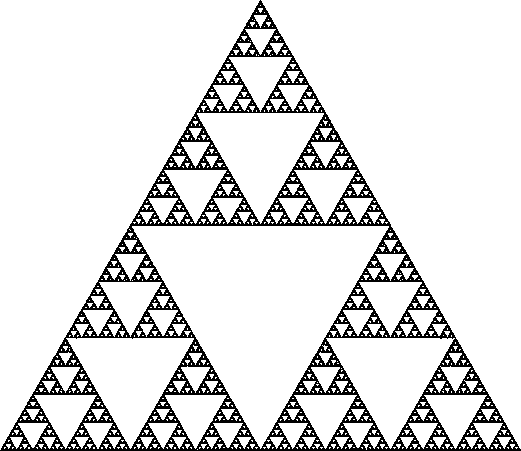
Fractals are increasingly complex patterns that reiterate themselves through feedback loops. An initially simple form is repeated to create higher order forms that reflect the exact same pattern. A classic example is the Sierpinski triangle:  


They are found throughout nature in river systems, snowflakes, fault lines, crystals, and soil pores. They are found throughout life in the structure of the trees, small intestines, blood vessel capillaries, heart rate, DNA and chromosomes. They are found in the mind as neural networks

Fractals are necessary and unavoidable, an integral part of nature. Their power lies in their simplicity, repeating the same geometric function endlessly requires only that initial pattern and creates enormously complex systems. For example, let's look at the small intestines. The whole organ is over 20 feet long but is able to condense into our abdominal cavity. Within the organ are villi or tiny folds. On each villi are microvilli that fold up even more. With each level of folding comes an increase in surface area, such that the lining of the small intestine is about 100 square feet. This is important since the small intestine absorbs vital nutrients for the body. The more surface area the more opportunity for absorption, increasing the fitness of an individual. Fractals work by maximizing efficiency while minimizing the work to achieve it.


If fractals exist in matter and life it stands to reason that they also exist within the mind. This brings us to karma and the Hindu notion of samskaras. Samskaras are grooves left on the mind with every action, experience, or thought. Every day we are bombarded with tens of thousands of stimuli, think thousands of thoughts, and perform hundreds of actions. Each and every one of those leaves an imprint on the mind. The more an action is performed, a stimuli is received, a thought is thunk the deeper those grooves get and most of us have no idea that it's going on. 

This is how habits are formed. You get up the same time each morning, you eat lunch at the same place each day, you react the exact same way your uncle brings up politics, etc. This is all in an attempt to make sense of the world, to be more efficient. Without our habits, processes, biases and beliefs it would be impossible to function in the world. 


Samskaras go deep into our subconscious and the more often or more powerful the stimuli, the deeper the samskara. This is why New Year's resolutions are such a bitch, they require uprooting years of habitually laid down behavior and require months to years to take effect. This is also why much of what we do is impulsive and unconscious. The brain runs a lot more efficiently on autopilot then it does on conscious control and autopilot is the culmination of processes the subconscious has accrued over time. It goes the same for good or bad habits, whether you're an alcoholic or a gym rat the more you grease the grooves of the mind the more automatic and necessary behaviors become. 

It gets more complicated. Samskaras that are related interconnect and become superstructures in the mind called vasanas. You wake up late... again (for some reason you just can never go to bed on time); you're tired and hungry; you race to work and realize that you forgot to turn off the light in the kitchen (again? that's the 4th time this week!), you're pissed, you bite your already bitten nails; you pass McDonald's, a feeling arises: a rumble in the belly, warmth in the chest, a dizzying pleasure in the center of your head; without thinking you pull up to the drive-through and order a mcgriddle with coffee; before you know it you've eaten everything; wait, weren't you supposed to quit fast-food as a New Year's resolution? Hadn't you gone a whole week without it? What's going on?

Well, the answer for many Hindus and Buddhists is simple: samskaras and vasanas. It goes back to karma: everything you do has a consequence, or "God said take what you want and pay for it". On top of that neuroscience is backing up what yogis have known for thousands of years. The brain basically works like a social networking site, making connections where they are relevant and strengthening those connections with repetition. This is neuroplasticity: the structure of the brain changes in response to its environment, or, "neurons that fire together wire together". While the brain has a definite structure and developmental track (no tabula rasa here) we are by and large just a collection of neural networks and processes that are subject to change throughout our entire lifetimes. These processes are largely unconscious and automatic.


This has several implications: 
The mind in order to maximize efficiency is always on autopilot
To process the infinite number of stimuli that come into our field of awareness at any given time the mind leaves impressions (samskaras) on the brain by strengthening neural pathways associated with those connections. This is the fractal nature of the mind. Nancy Reagan was unfortunately misguided with her "Just say no" campaign. Any attempt to simply "say no" to habitual behavior doesn't work because
Using willpower to fight habit is like fighting fire with hot air
Our habits are largely unconscious and the more rooted they are the more difficult they are to work against. It's blissfully ignorant to assume that a junkie who's been dependent on heroine for 10 years or a type II diabetic who has been resorting to fast food for nutrition her entire life is just going to wake up one day and undo years of learned behavior. But it goes both ways because
We can use samskaras to our advantage
Don't fight fire with hot air, fight fire with fire. If habits are a culmination of impressions left on our mind then by intentionally leaving impressions we can form new habits and discontinue old ones. While it may seem daunting to quit tobacco, regularly exercise or to floss our teeth each night these behaviors are only uncomfortable as long as they are novel. Most people think they need to start strong and set huge goals. No. Start small and don't worry about goals. Just do it every day, for a minute, then two minutes, then five minutes. Make a new behavior automatic and then strengthen it. Until it's habit any attempt to go strong and hard will likely overwhelm you, because
All we are is a collection of samskaras and vasanas
Yep, you're not anything but a construct of various processes. This may seem intimidating but the truth is that the notion of the "self" or "ego" is just a composition of lived experience that is subject to change at any point in time. Many people neglect to do things because they fall into "I'm bad at sports, I have an addictive nature, I just don't have enough time, I was born this way". These are processes that the mind has constructed in order to make sense of how it perceives reality but they are also processes that limit every one of us. Trying to forcibly change those processes is like uprooting a great oak. Therefore 
Behavior change is a matter of changing habits, not setting goals.
While setting goals is a nice way to benchmark progress, it's a means to an end. Life is all about the journey, not the destination and spending energy on external rather than internal objectives inevitably leads to failure. (Cue failed New Year's resolutions here). 

So in the face of the tsunami of habit ready to sweep us away into mindless behavior, what can we do? The yogis of past and present recommend just being non-judgmentally aware. If we know a samskara for what it is, it loses power over us. This puts us in a position to actually do something about it. The second part is even more important: non-reactivity. We tend to put a lot of emphasis in this culture on willpower and its power to change. Not only does this falsely sublimate willpower but it presupposes that if people can't change they have some sort of deficiency. 

None of us are perfect, it's what makes us human, it's what makes each and every one of us so fucking beautiful. Our imperfections and idiosyncrasies are an advantage, they are manifestations of creative spirit radiating out of us in unsurpassed splendor. By judging ourselves or others we don't accomplish anything, by accepting we put ourselves in a position to change. Not easily, noone ever said it was easy. But it is possible, step by step, day by day, samskara by samskara to become the best possible versions of ourselves.