"Beautiful, damn hard, increasingly useful. That's fractals." - Mandelbrot
“Between life’s stimuli and our habitual responses exists choice.” - Integral Life Practice
Virtues have to be practiced until they become your nature. Friendliness, compassion and meditation should continue as practices until you realize that they are your very nature.
The flaw in doing something as an act is that you look for a result. When it is done as your nature, you are not attached to the result and you continue doing it.
- Sri Sri Ravi Shankar

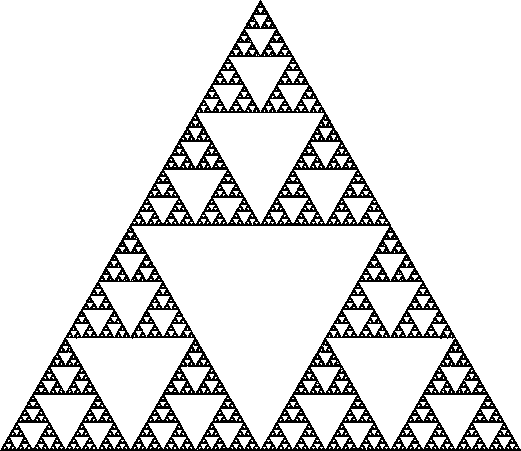
They are found throughout nature in river systems, snowflakes, fault lines, crystals, and soil pores. They are found throughout life in the structure of the trees, small intestines, blood vessel capillaries, heart rate, DNA and chromosomes. They are found in the mind as neural networks
Fractals are necessary and unavoidable, an integral part of nature. Their power lies in their simplicity, repeating the same geometric function endlessly requires only that initial pattern and creates enormously complex systems. For example, let's look at the small intestines. The whole organ is over 20 feet long but is able to condense into our abdominal cavity. Within the organ are villi or tiny folds. On each villi are microvilli that fold up even more. With each level of folding comes an increase in surface area, such that the lining of the small intestine is about 100 square feet. This is important since the small intestine absorbs vital nutrients for the body. The more surface area the more opportunity for absorption, increasing the fitness of an individual. Fractals work by maximizing efficiency while minimizing the work to achieve it.

If fractals exist in matter and life it stands to reason that they also exist within the mind. This brings us to karma and the Hindu notion of samskaras. Samskaras are grooves left on the mind with every action, experience, or thought. Every day we are bombarded with tens of thousands of stimuli, think thousands of thoughts, and perform hundreds of actions. Each and every one of those leaves an imprint on the mind. The more an action is performed, a stimuli is received, a thought is thunk the deeper those grooves get and most of us have no idea that it's going on.
This is how habits are formed. You get up the same time each morning, you eat lunch at the same place each day, you react the exact same way your uncle brings up politics, etc. This is all in an attempt to make sense of the world, to be more efficient. Without our habits, processes, biases and beliefs it would be impossible to function in the world.

Samskaras go deep into our subconscious and the more often or more powerful the stimuli, the deeper the samskara. This is why New Year's resolutions are such a bitch, they require uprooting years of habitually laid down behavior and require months to years to take effect. This is also why much of what we do is impulsive and unconscious. The brain runs a lot more efficiently on autopilot then it does on conscious control and autopilot is the culmination of processes the subconscious has accrued over time. It goes the same for good or bad habits, whether you're an alcoholic or a gym rat the more you grease the grooves of the mind the more automatic and necessary behaviors become.
It gets more complicated. Samskaras that are related interconnect and become superstructures in the mind called vasanas. You wake up late... again (for some reason you just can never go to bed on time); you're tired and hungry; you race to work and realize that you forgot to turn off the light in the kitchen (again? that's the 4th time this week!), you're pissed, you bite your already bitten nails; you pass McDonald's, a feeling arises: a rumble in the belly, warmth in the chest, a dizzying pleasure in the center of your head; without thinking you pull up to the drive-through and order a mcgriddle with coffee; before you know it you've eaten everything; wait, weren't you supposed to quit fast-food as a New Year's resolution? Hadn't you gone a whole week without it? What's going on?
Well, the answer for many Hindus and Buddhists is simple: samskaras and vasanas. It goes back to karma: everything you do has a consequence, or "God said take what you want and pay for it". On top of that neuroscience is backing up what yogis have known for thousands of years. The brain basically works like a social networking site, making connections where they are relevant and strengthening those connections with repetition. This is neuroplasticity: the structure of the brain changes in response to its environment, or, "neurons that fire together wire together". While the brain has a definite structure and developmental track (no tabula rasa here) we are by and large just a collection of neural networks and processes that are subject to change throughout our entire lifetimes. These processes are largely unconscious and automatic.

This has several implications:
The mind in order to maximize efficiency is always on autopilot
To process the infinite number of stimuli that come into our field of awareness at any given time the mind leaves impressions (samskaras) on the brain by strengthening neural pathways associated with those connections. This is the fractal nature of the mind. Nancy Reagan was unfortunately misguided with her "Just say no" campaign. Any attempt to simply "say no" to habitual behavior doesn't work because
Using willpower to fight habit is like fighting fire with hot air
Our habits are largely unconscious and the more rooted they are the more difficult they are to work against. It's blissfully ignorant to assume that a junkie who's been dependent on heroine for 10 years or a type II diabetic who has been resorting to fast food for nutrition her entire life is just going to wake up one day and undo years of learned behavior. But it goes both ways because
We can use samskaras to our advantage
Don't fight fire with hot air, fight fire with fire. If habits are a culmination of impressions left on our mind then by intentionally leaving impressions we can form new habits and discontinue old ones. While it may seem daunting to quit tobacco, regularly exercise or to floss our teeth each night these behaviors are only uncomfortable as long as they are novel. Most people think they need to start strong and set huge goals. No. Start small and don't worry about goals. Just do it every day, for a minute, then two minutes, then five minutes. Make a new behavior automatic and then strengthen it. Until it's habit any attempt to go strong and hard will likely overwhelm you, because
All we are is a collection of samskaras and vasanas
Yep, you're not anything but a construct of various processes. This may seem intimidating but the truth is that the notion of the "self" or "ego" is just a composition of lived experience that is subject to change at any point in time. Many people neglect to do things because they fall into "I'm bad at sports, I have an addictive nature, I just don't have enough time, I was born this way". These are processes that the mind has constructed in order to make sense of how it perceives reality but they are also processes that limit every one of us. Trying to forcibly change those processes is like uprooting a great oak. Therefore
Behavior change is a matter of changing habits, not setting goals.
While setting goals is a nice way to benchmark progress, it's a means to an end. Life is all about the journey, not the destination and spending energy on external rather than internal objectives inevitably leads to failure. (Cue failed New Year's resolutions here).
So in the face of the tsunami of habit ready to sweep us away into mindless behavior, what can we do? The yogis of past and present recommend just being non-judgmentally aware. If we know a samskara for what it is, it loses power over us. This puts us in a position to actually do something about it. The second part is even more important: non-reactivity. We tend to put a lot of emphasis in this culture on willpower and its power to change. Not only does this falsely sublimate willpower but it presupposes that if people can't change they have some sort of deficiency.
None of us are perfect, it's what makes us human, it's what makes each and every one of us so fucking beautiful. Our imperfections and idiosyncrasies are an advantage, they are manifestations of creative spirit radiating out of us in unsurpassed splendor. By judging ourselves or others we don't accomplish anything, by accepting we put ourselves in a position to change. Not easily, noone ever said it was easy. But it is possible, step by step, day by day, samskara by samskara to become the best possible versions of ourselves.

No comments:
Post a Comment